At this point, I'm about halfway done writing this paper. I actually have a significant amount of information on savings/retirement savings, so I may not even need to include credit cards in my analysis. I might mention it briefly, simply because it is a really interesting aspect of economics and psychology.
Right now, I'm working on the "solutions" part of my essay--how behavioral economics (and not classical economics) can provide useful solutions to avoiding/getting out of this current savings mess. Economics professors and authors Dan Ariely and Richard Thaler have been crucial sources for this part. They both propose solutions that are both simple and obvious, making me wonder why they have not been implemented yet.
Most of Thaler's solutions revolved around the 401(k) plan and other retirement plans; since these plans are already out there, it makes sense to just alter these ones instead of creating an entirely new solution. He suggests ideas such as automatic enrollment and a simplification of the enrollment process, both of which have shown to drastically increase participation rates in isolated experiment.
Thaler's other idea is an entirely new plan, and he even coined it the "Save More Tomorrow" plan. This plan takes advantage of hyperbolic discounting (again, how people seem to value their time/money today rather than in the future), which makes it very tied to behavioral economics. In this plan, new employees decide what percentage of their future salary raises they would want to invest in retirement plans. This way, they aren't affected by today's salary, eliminating the effect of hyperbolic discounting. I'll definitely explore this idea as I continue to write my paper.
Tuesday, July 26, 2011

Wednesday, July 20, 2011
Topics to Explore
My research is well underway at this point, and I've come across some very interesting topics that I plan on incorporating into my overall essay on savings. One topic I'd like to include is credit cards. Credit cards have entirely changed the landscape of money in the past few decades, enabling people to spend well beyond their means. Here are some facts about savings and credit cards (taken from Dan Ariely's Predictably Irrational) from right before the economic crash:
Average American savings rate in 1994: 5%
Average American savings rate by 2006: below 0
Average European savings rate 2008: 25%
Average Japanese savings rate 2008: 50%
Average number of credit cards per family: 6
Average debt on credit cards per family: $9,000
Percentage of households that borrow on credit cards to cover basic living expenses: 70%
I'm hoping to be able to use these facts and apply them to a cohesive thesis about why behavioral economics is so crucial to understanding why Americans are terrible savers, and what this means for the future of the country.
Another example I'll use is retirement savings (focusing on the 401(k) and why people often opt out of it). By using retirement savings, I'll have a solid example with which I can explain savings from a more concrete perspective.
Lastly, I've started reading Ariely's newest book, The Upside of Irrationality. This book is far more psychological than economical, but I'm finding it super interesting (even if mildly irrelevant to my paper topic). Topics include the "IKEA effect" (where you get attached to items if you help build them yourself), why people seek revenge, ideas on beauty, and an analysis of online dating. Interesting, right?
Average American savings rate in 1994: 5%
Average American savings rate by 2006: below 0
Average European savings rate 2008: 25%
Average Japanese savings rate 2008: 50%
Average number of credit cards per family: 6
Average debt on credit cards per family: $9,000
Percentage of households that borrow on credit cards to cover basic living expenses: 70%
I'm hoping to be able to use these facts and apply them to a cohesive thesis about why behavioral economics is so crucial to understanding why Americans are terrible savers, and what this means for the future of the country.
Another example I'll use is retirement savings (focusing on the 401(k) and why people often opt out of it). By using retirement savings, I'll have a solid example with which I can explain savings from a more concrete perspective.
Lastly, I've started reading Ariely's newest book, The Upside of Irrationality. This book is far more psychological than economical, but I'm finding it super interesting (even if mildly irrelevant to my paper topic). Topics include the "IKEA effect" (where you get attached to items if you help build them yourself), why people seek revenge, ideas on beauty, and an analysis of online dating. Interesting, right?
Tuesday, July 12, 2011
Narrowing in on a topic
After presenting last Thursday on behavioral economics in general, with no real thesis besides "irrationality," I think I've finally gathered enough information to focus in on a real topic. Presenting was actually very helpful, as the class seemed involved and ready to help me with ideas. A lot of people liked the Tiger Woods/celebrity approach to irrationality (excess money = power trip, reckless behavior). Others said I should take one aspect of behavioral economics (framing, anchoring, hyperbolic discounting, etc) and explore just that. But the topic that I feel will be the most enlightening/beneficial/interesting is personal savings. If I use this topic as the base of my paper (perhaps focusing on how this played into the economic/housing crisis), I can branch off into many different aspects of behavioral economics. I can use hyperbolic discounting (which is, again, how people tend to regard present time as much more valuable than future time) from behavioral economics, promises/promise breaking from psychology, and facts and figures about savings/the economic crisis from economics. Also, savings will provide me with plenty of examples and experiments that are mildly related to the topic, so I doubt that I will run out of things to discuss.
Also:
Here is the video that I showed a clip of during my presentation. The full clip is very interesting, I just didn't have time to show it all during class.
Also:
Here is the video that I showed a clip of during my presentation. The full clip is very interesting, I just didn't have time to show it all during class.
Wednesday, July 6, 2011
New focus: irrationality
After researching behavioral economics for assignment #3, I've decided that the main focus of my essay will be on the idea of irrationality. Since there are so many instances of irrationality in the news (i.e, people doing things that are just plain dumb), it'll be easier to find ways to connect behavioral economics to topics that are relevant today.
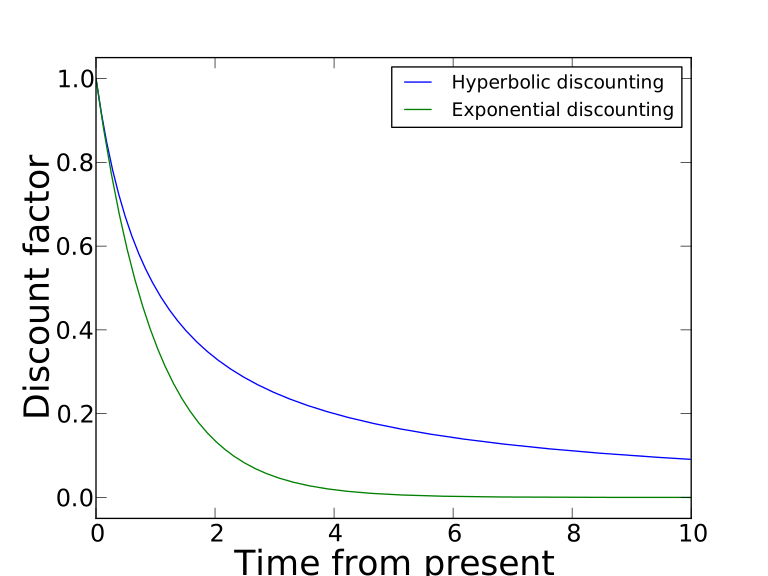
Also, irrationality is something that everybody is familiar with, to varying degrees. Often times, we don't even recognize that some decisions that we make are irrational. For instance, one of the topics I've been researching is called hyperbolic discounting. According to Wikipedia, "humans show a preference for one that arrives sooner rather than later. Humans are said to discount the value of the later reward, by a factor that increases with the length of the delay" ("Hyperbolic Discounting"). It's "hyperbolic" because the discounting factor eventually reaches an asymptote and levels out. Here's a graphical explanation, which may or may not be helpful ("Hyperbolic Discounting"):

Hyperbolic discounting works for responsibilities/pains/tasks/etc as well, just reverse. People prolong doing difficult tasks because they feel that the value of their time at the moment is higher than in the future, or that the pain they feel in the future will be somehow less strong.
While this topic has a very scientific and mathematical background (see: "Golden Eggs and Hyperbolic Discounting" by David Laibson), it also applies to everyday occurrences, making this topic relevant to our lives and important to understand.
Works Cited
"Hyperbolic Discounting ." Wikipedia. Wikimedia Foundation, Inc., 12 Jun 2011. Web. 6 Jul 2011.
Also, irrationality is something that everybody is familiar with, to varying degrees. Often times, we don't even recognize that some decisions that we make are irrational. For instance, one of the topics I've been researching is called hyperbolic discounting. According to Wikipedia, "humans show a preference for one that arrives sooner rather than later. Humans are said to discount the value of the later reward, by a factor that increases with the length of the delay" ("Hyperbolic Discounting"). It's "hyperbolic" because the discounting factor eventually reaches an asymptote and levels out. Here's a graphical explanation, which may or may not be helpful ("Hyperbolic Discounting"):
Hyperbolic discounting works for responsibilities/pains/tasks/etc as well, just reverse. People prolong doing difficult tasks because they feel that the value of their time at the moment is higher than in the future, or that the pain they feel in the future will be somehow less strong.
While this topic has a very scientific and mathematical background (see: "Golden Eggs and Hyperbolic Discounting" by David Laibson), it also applies to everyday occurrences, making this topic relevant to our lives and important to understand.
Works Cited
"Hyperbolic Discounting ." Wikipedia. Wikimedia Foundation, Inc., 12 Jun 2011. Web. 6 Jul 2011.
Subscribe to:
Comments (Atom)